What Is a Vocabulary Crossword? The Learning Puzzle Between Crosswords and Flashcards
October 3, 2026
A normal crossword rewards recognition: map clue to answer, fit answer to grid, move on. A flashcard often rewards a different shortcut: memorize the wording on the back of the card. A vocabulary crossword earns the name only when the grid forces contextual recall of useful words, then brings those words back on a schedule before they fade.
That category matters because word-game time can either be disposable entertainment or retrieval practice: forcing memory to produce an answer, not merely nod along when the answer appears.
A vocabulary crossword trains recall, not crossword trivia
A themed crossword about “SAT words” is not automatically a vocabulary crossword. If the clue is just “obstinate” and the answer is stubborn, the puzzle has tested synonym lookup under letter constraints. Useful, sometimes. Thin.
The stronger form has three requirements:
— The target words are selected for vocabulary growth, not because they happen to fit a cute grid theme.
— The clue gives a situation, grammar, and meaning pressure, so the solver has to retrieve the word in context.
— The word returns later under a memory schedule, because one correct answer is not learning.
Lexi is built around that stricter definition: spaced repetition delivered as dynamically generated crossword puzzles. The puzzle is the interface; the word is the unit of memory.
Context beats definition recitation
Definitions are useful for introducing a word. They are weak as the sole thing being memorized, because the learner can overfit to a phrasing. If the prompt is always “reach a conclusion from clues or facts,” you may learn that sentence more than you learn deduce.

A Lexi word card can introduce deduce as “reach a conclusion from clues or facts,” with the example sentence: “From the muddy tracks, we deduce the thief fled toward the river.” That is the right first contact: definition, example, image, connotation.
But the crossword should then make you produce the word. Turn the sentence into a fill-in-the-blank test: “From the muddy tracks, we _____ the thief fled toward the river.” The answer is constrained by syntax, meaning, and use. You are not reciting a dictionary line. You are choosing the verb that belongs in the thought.
Lexi’s clues are fill-in-the-blank sentences plus a meaning-evoking hint. Recall happens in context, not against a bare definition.
A vocabulary crossword should never quiz you cold
Cold quizzing is fake rigor. If you have never met a word, failing to retrieve it proves nothing about memory; there is no memory trace to retrieve.
Lexi introduces every word you have never seen with its word card before the puzzle. You get the image, definition, example sentence, and connotation tags first. Then the puzzle asks you to recall it.
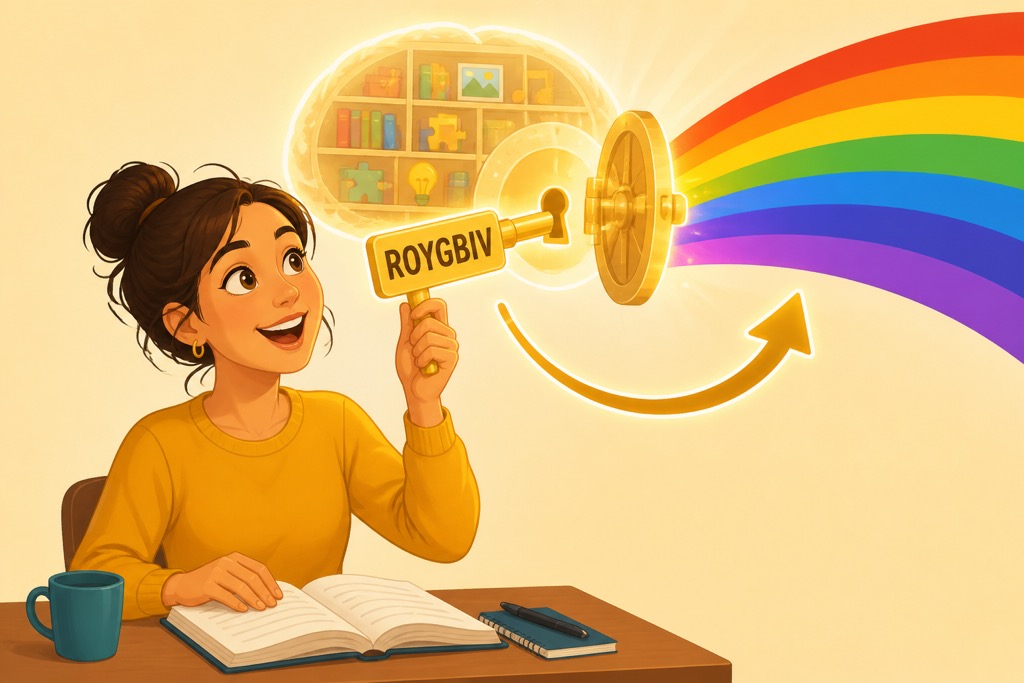
For mnemonic, the card definition is “a device (such as a rhyme or acronym) used to aid recall,” with the example: “To memorize the colors of the rainbow, she used the mnemonic 'ROYGBIV.'” The card is not the whole lesson. It is ignition. The crossword supplies the first retrieval attempt; later puzzles supply the repetitions.
This is why the category sits between worksheets and flashcards. A worksheet may introduce a list and ask you to fill a grid once. A flashcard system may schedule reviews but leave you flipping isolated prompts. A vocabulary crossword needs both: contextual recall and a per-word schedule.
I wrote more on the scheduling side in A Spaced Repetition Vocabulary App Without Flashcards, but the short version is simple: memory needs timed return, not heroic repetition on day one.
Fixed clues create prompt overfitting
A common failure mode in vocabulary practice is learning the clue instead of the word. If obdurate always appears beside “stubborn,” the association becomes brittle. Meet the word in a novel, a review, or a legal argument, and the memorized pairing may not fire.
Lexi avoids that by giving every word multiple differently phrased clues — currently 3 per word — under one spaced-repetition schedule per word. The schedule belongs to the underlying word, not to a single clue sentence. Different surface forms train the same item from several angles, so there is no fixed prompt to hide behind.
That choice makes content production harder. Lexi’s clues are produced by an iterative Creator → Validator → Guesser → Reviser pipeline using frontier language models. A clue can undergo up to 7 revisions before acceptance, against quality criteria refined through repeated in-app revision rounds. The point is not to generate more text. The point is to generate clues that make the target word recoverable for the right reason.
The grid should reduce frustration without removing retrieval
Cross letters are not cheating. They are controlled partial information.
In a blank text field, a learner can stall completely. In a multiple-choice question, the answer is visible, so recognition can masquerade as recall. A crossword sits between those extremes: the clue asks for meaning, the grid supplies structure, and crossing answers provide letters only as the puzzle develops.
That interaction changes the labor. You may retrieve a word from the clue first, then confirm it with the grid. Or you may get two letters from crossing entries, then use the clue to finish the word. Both routes still require producing the answer.
Lexi also removes a second source of labor: self-grading. Spaced-repetition systems often ask you to choose Again, Hard, Good, or Easy. That is review homework plus a metacognitive guess. Lexi infers grading automatically from solve timing — fast, normal, or slow — normalized for clue and word length. The app observes the retrieval event instead of asking you to judge it.
For a broader version of the same argument, see Vocabulary Crossword Puzzles That Teach by Retrieval.
The puzzle is the delivery layer; the word is the memory object
A vocabulary crossword without spaced repetition is a one-off game. Enjoyable, but amnesic: the puzzle does not know which words nearly stuck, which words are due, or which words should wait.
Lexi’s dataset has 20,000 words ordered roughly by rarity for maximal real-world utility per unit time spent. About 3,000 currently have pipeline-grade clues; the first ~1,500 have illustrated word cards. In Lexi, spaced repetition is delivered as dynamically generated crossword puzzles. The crossword is the delivery layer for scheduled retrieval, not a standalone one-time puzzle.
That distinction is the category. A crossword app can be entertainment-first. A vocabulary app can be flashcard-first. A vocabulary crossword should use the pleasure of solving as the carrier for a real memory system.
The same principle applies to nuance. Recognizing a word is often easier than recalling it when needed; I covered that failure mode in Why you recognize a word but can’t find it when you need it. A crossword clue narrows the target enough to make recall possible, but not so much that the answer is merely recognized.
The honest boundary
Do not use Lexi if you need Android, non-English vocabulary, or exhaustive polysemy today: it is English-only, iOS-only, and one sense per word so far.
Try Lexi: it is free on iPhone and iPad, with no ads at all. Download Lexi: Vocabulary Crosswords on the App Store.