Vocabulary Crossword Game for Adults: Learn New Words by Solving
October 4, 2026
A vocabulary crossword game works only if the crossword is downstream of the review schedule. If the grid comes first, you get entertainment plus incidental exposure. If the schedule comes first, each square becomes a retrieval rep for a word your memory is ready to strengthen.
That is the design line Lexi sits on: not a generic crossword app with difficult clues, and not a flashcard deck dressed up as a word game. The puzzle is the delivery mechanism for spaced repetition — review timed by memory, not by whatever puzzle happens to be next.
A vocabulary crossword game should start with due words
Most crossword play trains clue-solving skill. That is real skill, but it is not the same thing as durable vocabulary growth.
A normal crossword can teach a word incidentally: you see ersatz, infer it from crossings, and maybe remember it later. The problem is scheduling. Memory decays unevenly. A word you solved once needs to reappear when it is close to being forgotten, then later, then later again. Without that timing, the puzzle is an exposure machine, not a learning system.
Flashcards solve the scheduling problem and create a different one: they make review feel like review. You stare at a prompt, produce an answer, and press Again/Hard/Good/Easy. That works for arbitrary facts. It is a poor fit for people who came for wordplay.
Lexi makes the grid serve the schedule. It teaches vocabulary through spaced repetition delivered as dynamically generated crossword puzzles. The app decides which words are due, then builds play around them.
That inversion matters. The crossword is the retrieval interface.
Definition cards train the wrong association
A definition card trains a brittle association: word ↔ phrasing. If the prompt is always “obstinate; stubbornly refusing to change,” you can learn the verbal shape of the card without being able to use the word in a sentence. That is overfitting: performance improves on the training prompt while transfer stays weak.
Lexi uses clues that are fill-in-the-blank sentences plus a meaning-evoking hint. Recall happens in context, not against a definition.
A clue for brevity should force the concept of using few words, not the memorization of a dictionary line. The word card defines it as “using few words,” with the example sentence: “The mayor's brevity is unmistakable as he tells the cameras, "Taxes drop. Roads reopen."”
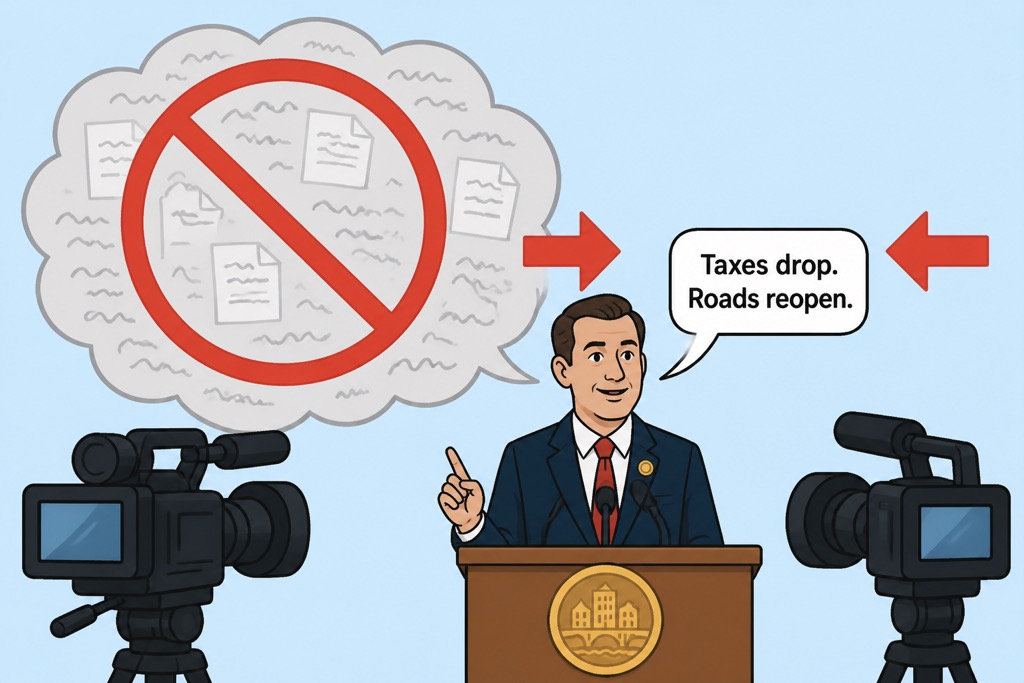
That example does more than illustrate. It compresses the meaning into a usable scene: cameras, a mayor, two blunt sentences. When the later crossword clue asks for the word from a different angle, you are retrieving the idea, not reciting the card.
Lexi also cycles every word through multiple differently phrased clues — currently 3 per word — under one spaced-repetition schedule per word. These are different surface forms of a single underlying item, so there is no fixed phrasing to overfit to.
For a deeper version of this mechanism, see Vocabulary Crossword Puzzles That Teach by Retrieval.
The word should be introduced before it is tested
Cold quizzes waste attention. If you have never seen a word, failing to retrieve it proves nothing. It only proves the app asked an impossible question.
Lexi introduces every never-seen word with a word card before the puzzle. The cards are styled like collectible game cards: an image designed to evoke the meaning, a definition, an example sentence matching the image, and connotation tags.
Then the crossword asks you to recall it. That sequence is the minimum viable learning loop:
— encounter the word with meaning attached
— retrieve it in a sentence
— use crossings as constraints without turning the task into multiple choice
— see it again when spaced repetition says it is due
The result feels like a word game because the action is solving. It functions like a memory system because the recurrence is scheduled.
Timing-based grading fits crossword review better than self-grading
Self-grading interrupts the loop. After every flashcard, you must decide how well you knew the answer. That decision is noisy: confidence, mood, and impatience leak into the grade.
Lexi infers SRS grading automatically from solve timing: fast, normal, or slow, normalized for clue and word length. No Again/Hard/Good/Easy buttons. No self-rating after every answer.
This is especially natural inside a crossword. The app already has the signal it needs: how long retrieval took. Fast recall and slow reconstruction are different memory states. They should not receive the same next review interval.
That is the point of a learning-native puzzle. The game should generate the data the memory system needs without asking the player to become a clerk.
A learning crossword needs maintained clues, not a static clue list
Bad vocabulary clues are easy to write. Good ones have to avoid ambiguity, cue the intended word, fit the sentence, and not collapse into synonym trivia.
I built Lexi’s clue pipeline as an iterative Creator → Validator → Guesser → Reviser system using frontier language models. A clue can undergo up to 7 revisions before acceptance, against quality criteria refined through repeated in-app revision rounds.
The dataset is 20,000 words ordered roughly by rarity for maximal real-world utility per unit time spent. About 3,000 words currently have pipeline-grade clues. The first about 1,500 words have illustrated word cards.
Definitions, clues, and images are continuously revised from in-app user feedback via regular updates (v1.163 as of Sept 2026). The content is maintained, not a static deck.
That is why Lexi is more than “crosswords with bigger words.” The important object is the word’s memory state. The grid, clue, card, and future review all orbit that object.
A vocabulary learning game has to sit between crossword apps and flashcard apps
Entertainment-first crossword apps optimize for puzzle supply. Flashcard apps optimize for review control. A vocabulary crossword game has to optimize for learning through play.
That means the puzzle cannot merely contain vocabulary. It has to enforce retrieval at the right time, vary the clue surface, introduce unknown words before testing them, and grade without breaking flow.
Lexi is built for that intersection: dynamically generated crossword puzzles, contextual fill-in-the-blank clues, one spaced-repetition schedule per word, automatic timing-based grading, and no ads on iPhone or iPad. It is free on iPhone and iPad with no ad-removal purchase because there is nothing to remove.
If you are comparing the category against decks, A Spaced Repetition Vocabulary App Without Flashcards covers the anti-flashcard design in more detail.
The limits define the shape
Lexi is English-only and iOS-only. It trains one sense per word so far, so it does not yet handle polysemy. Word-card images cover the first about 1,500 words, while the broader clue system reaches about 3,000 words.
I made those tradeoffs because depth beats nominal coverage. A smaller maintained system with real review mechanics teaches more per minute than a giant word list wearing a progress bar.
If you want Android, multilingual study, or arbitrary self-made decks for anatomy or kanji, Lexi is not the right tool.
Try Lexi: download Lexi: Vocabulary Crosswords on the App Store.